There is a scheduled power shutdown on South Campus starting Saturday 10/13 at 8PM and ending Sunday 10/14 at 8PM. The BIRC facility will not be accessible during the shutdown. The NiDB, wiki, and scheduler systems will not be affected.
Author: Elisa Medeiros
Talk: Functional MRI Studies of Memory and Navigation
Chantal Stern, D.Phil
Boston University, Psychological and Brain Sciences
Wednesday, September 19 2018 3:30-4:30PM in BOUS A106
Biography:
Stern is an expert in human brain imaging and was a member of the research team that pioneered the development of functional magnetic resonance imaging, including early work focusing on the human hippocampus. Her lab’s primary goal is to study how the normal brain encodes, stores, and subsequently recognizes visual, spatial, and verbal information. In addition to studies of normal memory processes, including long-term and short-term memory processes, Stern and her team are studying basic science questions that include understanding spatial navigation, rule-learning, and interactions between memory and attention. Her translational work focuses on Alzheimer’s and Parkinson’s diseases. Thanks to a $1.6 million National Science Foundation instrumentation grant that Stern secured in 2016, her center showcases a Siemens 3 Tesla Magnetic Resonance Imaging scanner—a fundamental tool for studying the human brain. (Biography courtesy of www.bu.edu)
Vistors from UCHC are encourage to use the UCHC-Storrs shuttle service. Talks can also be joined remotely. Please contact us if you are interested in meeting with the speaker.
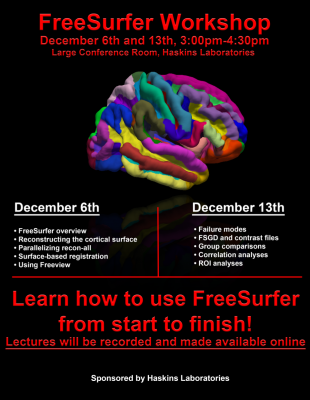
Interested in analyzing structural MRI data? Freesurfer workshop, 12/6-12/13
You are invited to attend a Freesurfer workshop at Haskins in December — please see the flyer for details.
No experience is required. Please bring a laptop for the 2nd session.Please contact Andy Jahns with questions: andrew.jahn@yale.edu
New England Research on Dyslexia Society Meeting October 21
The 3rd meeting of the New England Research on Dyslexia Society will be held in Storrs, CT on October 21, 2017. The meeting will take place on the University of Connecticut campus in Oak Hall.
KEYNOTE SPEAKER: John Gabrieli, Ph.D, Professor of Brain and Cognitive Sciences, MIT
“Dyslexia: From Neurophysiology to Intervention”
The New England Research Group on Dyslexia is an interdisciplinary community of researchers, educators, clinicians, and policy experts, whose work aims at elucidating the biological, including psychological, and social underpinnings of Developmental Dyslexia and related disorders with the objective of improving prevention, early detection, diagnosis, treatment/intervention and social support (including legal, political, and public health) associated with this learning disability.
Registration is closed.
BOLD Brownbag Series
BIRC is pleased to present a series of informal BOLD Brownbag talks, held on Wednesdays from 9-10 AM in Bous 162. If you are not currently on the MRI distribution list, but would like to hear updates about these talks, please join the list serve. This venue is an informal one, geared toward discussion of work in progress (especially methodological/analytical) rather than formal polished presentations of finished products (though we’ll have some of those as well!).
You can find the current schedule here.
Change in leadership at BIRC
After serving as Director since BIRC’s inception, Jay Rueckl will taking a well-earned sabbatical leave. Inge-Marie Eigsti will step in as Acting Director of BIRC. Dr. Eigsti’s imaging research centers on neural circuitry underlying the processing of language and special interests in autism spectrum disorder (see a recent article here).
Appointment of Dr. Roeland Hancock
The BIRC pleased to announce the appointment of Dr. Roeland Hancock as Associate Director of the Brain Imaging Research Center. Roeland received a PhD in Psychology from the University of Arizona. Since 2013, he has been a Postdoctoral Fellow at the University of California, San Francisco working with Fumiko Hoeft, an innovative leader in MRI research. Roeland has expertise in functional, structural and spectroscopic magnetic resonance imaging, as well software development, project management, and magneto/electroencephalography.
Roeland’s research interests concern the neurobiological factors underlying individual variability in language processing and the application of new mathematical and computational techniques to understanding these processes. His most recent work has focused on the effects of neurochemistry on the neural dynamics of speech and auditory processing.
Roeland’s appointment will begin on June 23.
In the News: Autism Research
Follow this link to read about recent MRI research by UConn scientists investigating the effects of intervention for autism: