Here are some brief updates, which won’t impact any of you on the list serve (please note a virtual-only talk on 4/1 Wed).
BIRC news
BIRC’s response to the Coronavirus Outbreak Update #6 3-16-20
With many states and counties advancing into lockdown (SF is stating lockdown of the whole city together with neighboring counties effective tonight – just announced! I believe it will come our way to CT sooner than we think/hope. I hope I am wrong), we have made some adjustments.
We technically remain open until the university announcement, but …
RESEARCH SCANS
We have cancelled all research scans until 4/6 and will continue to discourage scanning unless you can convince us 🙂
CLINICAL SCANS
While UCHC has decided to only cancel elective surgery at this point, and no outpatient services are cancelled, we have agreed to cancel/postpone all clinical scans as well. We will scan the remaining patients if there are critical needs but have suspended all clinical scans at least until 4/6 as well. We are currently not booking any new patients. Thanks for Leo Wolansky (UCHC Radiology Department Chair)’s understanding in the service of protecting our staff.
Hence no disinfection will be done as complete telecommuting has started.
If you have critical needs please contact me.
Stay safe and happy…
Fumiko
BIRC’s response to the Coronavirus Outbreak Update #5 3-16-20
A quick update to you all.
RESEARCH SCANS
We are currently technically open. But we do not have any research scans until the weekend (and they are non-EEG) and will likely close as soon as we get guidance from VPR. They are in discussions and will propose recommendations to the President this afternoon. We are urging the university to stop all non-critical/essential research that does not impact human health ASAP. We should have updates before any further research scans are done.
CLINICAL SCANS
We are in discussions with UCHC Radiology to stop clinical MRI as well as they are non-priority scans.
OTHER ACTIVITIES
We remain open virtually for any consultations or training that can be done remotely. We will suspend in person MRI safety training until further notice. LMK if this impacts your research plans.
Please do not come in to use the conference rooms or data room unless necessary. While we have staff telecommute, we will not be disinfecting the areas as we had originally planned and was doing last week. If you do need to come in to BIRC, please contact me.
Thank you,
Fumiko
BIRC’s response to the Coronavirus Outbreak Update #4 3-13-20
At this time BIRC will continue to be fully operational. Any scheduled research will not be impacted, and investigators can schedule additional research times as needed.
Please note that we will be complying with the University’s request to have staff and faculty telecommute when possible and may not be in the facility during normal business hours; however, please feel free to email any questions to Fumiko Hoeft, Roeland Hancock, or Elisa Medeiros.
IBRAiN Office Hours
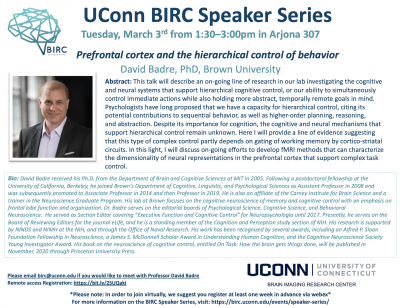
646 198 704 on UConn Webex.Talk: David Badre, Brown University
Tuesday, March 3rd from 1:30-3:00 pm in Arjona 307
Abstract:
This talk will describe an on-going line of research in our lab investigating the cognitive and neural systems that support hierarchical cognitive control, or our ability to simultaneously control immediate actions while also holding more abstract, temporally remote goals in mind. Psychologists have long proposed that we have a capacity for hierarchical control, citing its potential contributions to sequential behavior, as well as higher-order planning, reasoning, and abstraction. Despite its importance for cognition, the cognitive and neural mechanisms that support hierarchical control remain unknown. Here I will provide a line of evidence suggesting that this type of complex control partly depends on gating of working memory by cortico-striatal circuits. In this light, I will discuss on-going efforts to develop fMRI methods that can characterize the dimensionality of neural representations in the prefrontal cortex that support complex task control.
Bio:David Badre received his Ph.D. from the Department of Brain and Cognitive Sciences at MIT in 2005. Following a postdoctoral fellowship at the University of California, Berkeley, he joined Brown’s Department of Cognitive, Linguistic, and Psychological Sciences as Assistant Professor in 2008 and was subsequently promoted to Associate Professor in 2014 and then Professor in 2019. He is also an affiliate of the Carney Institute for Brain Science and a trainer in the Neuroscience Graduate Program. His lab at Brown focuses on the cognitive neuroscience of memory and cognitive control with an emphasis on frontal lobe function and organization. Dr. Badre serves on the editorial boards of Psychological Science, Cognitive Science, and Behavioral Neuroscience. He served as Section Editor covering “Executive Function and Cognitive Control” for Neuropsychologia until 2017. Presently, he serves on the Board of Reviewing Editors for the journal eLife, and he is a standing member of the Cognition and Perception study section of NIH. His research is supported by NINDS and NIMH at the NIH, and through the Office of Naval Research. His work has been recognized by several awards, including an Alfred P. Sloan Foundation Fellowship in Neuroscience, a James S. McDonnell Scholar Award in Understanding Human Cognition, and the Cognitive Neuroscience Society Young Investigator Award. His book on the neuroscience of cognitive control, entitled On Task: How the brain gets things done, will be published in November, 2020 through Princeton University Press.
Please email birc@uconn.edu if you are interested in meeting with a speaker. Click here to see the full BIRC Speaker Series schedule and access recordings of past talks.
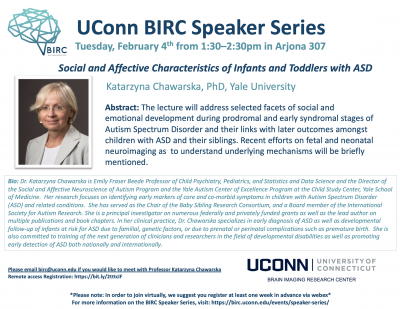
Talk: Katarzyna Chawarska, Yale University
Tuesday, February 4th from 1:30-3:00 pm in Arjona 307
Abstract:The lecture will address selected facets of social and emotional development during prodromal and early syndromal stages of Autism Spectrum Disorder and their links with later outcomes amongst children with ASD and their siblings. Recent efforts in fetal and neonatal neuroimaging to understand underlying mechanisms will be briefly mentioned.
Bio: Dr. Katarzyna Chawarska is Emily Fraser Beede Professor of Child Psychiatry, Pediatrics, and Statistics and Data Science and the Director of the Social and Affective Neuroscience of Autism Program and the Yale Autism Center of Excellence Program at the Child Study Center, Yale School of Medicine. Her research focuses on identifying early markers of core and co-morbid symptoms in children with Autism Spectrum Disorder (ASD) and related conditions. She has served as the Chair of the Baby Sibling Research Consortium, and a Board member of the International Society for Autism Research. She is a principal investigator on numerous federally and privately funded grants as well as the lead author on multiple publications and book chapters. In her clinical practice, Dr. Chawarska specializes in early diagnosis of ASD as well as developmental follow-up of infants at risk for ASD due to familial, genetic factors, or due to prenatal or perinatal complications such as premature birth. She is also committed to training of the next generation of clinicians and researchers in the field of developmental disabilities as well as promoting early detection of ASD both nationally and internationally.
Please email birc@uconn.edu if you are interested in meeting with a speaker. Click here to see the full BIRC Speaker Series schedule and access recordings of past talks.
Scheduling Seed Grant Studies During Spring 2020 Semester
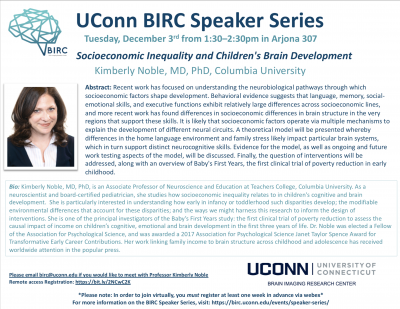
Talk: Kimberly Noble, Columbia University
Tuesday, December 3rd from 1:30-3:00 pm in Arjona 307
Abstract: Socioeconomic disparities in childhood are associated with remarkable differences in cognitive and socio-emotional development during a time when dramatic changes are occurring in the brain. Recent work has focused on understanding the neurobiological pathways through which socioeconomic factors shape development. Behavioral evidence suggests that language, memory, social-emotional skills, and executive functions exhibit relatively large differences across socioeconomic lines, and more recent work has found differences in socioeconomic differences in brain structure in the very regions that support these skills. It is likely that socioeconomic factors operate via multiple mechanisms to explain the development of different neural circuits. A theoretical model will be presented whereby differences in the home language environment and family stress likely impact particular brain systems, which in turn support distinct neurocognitive skills. Evidence for the model, as well as ongoing and future work testing aspects of the model, will be discussed. Finally, the question of interventions will be addressed, along with an overview of Baby’s First Years, the first clinical trial of poverty reduction in early childhood.
Bio:Kimberly Noble, MD, PhD, is an Associate Professor of Neuroscience and Education at Teachers College, Columbia University. She received her undergraduate, graduate and medical degrees at the University of Pennsylvania. As a neuroscientist and board-certified pediatrician, she studies how socioeconomic inequality relates to in children’s cognitive and brain development. Her work examines socioeconomic disparities in cognitive development, as well as brain structure and function, across infancy, childhood and adolescence. She is particularly interested in understanding how early in infancy or toddlerhood such disparities develop; the modifiable environmental differences that account for these disparities; and the ways we might harness this research to inform the design of interventions. She is one of the principal investigators of the Baby’s First Years study: the first clinical trial of poverty reduction to assess the causal impact of income on children’s cognitive, emotional and brain development in the first three years of life. Dr. Noble was elected a Fellow of the Association for Psychological Science, and was awarded a 2017 Association for Psychological Science Janet Taylor Spence Award for Transformative Early Career Contributions. Her work linking family income to brain structure across childhood and adolescence has received worldwide attention in the popular press.
Please email birc@uconn.edu if you are interested in meeting with a speaker. Click here to see the full BIRC Speaker Series schedule and access recordings of past talks.
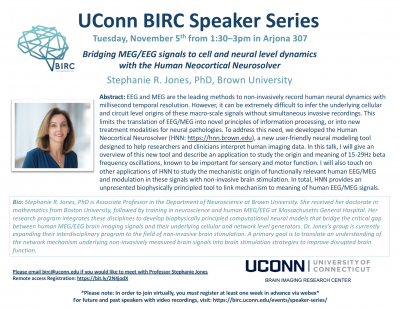
Talk: Stephanie Jones, Brown University
Brown University
Tuesday, November 5th from 1:30-3:00 pm in Arjona 307
Abstract: EEG and MEG are the leading methods to non-invasively record human neural dynamics with millisecond temporal resolution. However, it can be extremely difficult to infer the underlying cellular and circuit level origins of these macro-scale signals without simultaneous invasive recordings. This limits the translation of EEG/MEG into novel principles of information processing, or into new treatment modalities for neural pathologies. To address this need, we developed the Human Neocortical Neurosolver (HNN: https://hnn.brown.edu), a new user-friendly neural modeling tool designed to help researchers and clinicians interpret human imaging data. In this talk, I will give an overview of this new tool and describe an application to study the origin and meaning of 15-29Hz beta frequency oscillations, known to be important for sensory and motor function. I will also touch on other applications of HNN to study the mechanistic origin of functionally relevant human EEG/MEG and modulation in these signals with non-invasive brain stimulation. In total, HNN provides an unpresented biophysically principled tool to link mechanism to meaning of human EEG/MEG signals.
Bio: Stephanie R. Jones, PhD is Associate Professor in the Department of Neuroscience at Brown University. She received her doctorate in mathematics from Boston University, followed by training in neuroscience and human MEG/EEG at Massachusetts General Hospital. Her research program integrates these disciplines to develop biophysically principled computational neural models that bridge the critical gap between human MEG/EEG brain imaging signals and their underlying cellular and network level generators. Dr. Jones’s group is currently expanding their interdisciplinary program to the field of non-invasive brain stimulation. A primary goal is to translate an understanding of the network mechanism underlying non-invasively measured brain signals into brain stimulation strategies to improve disrupted brain function.
**To view this talk remotely via Webex, please register hereby October 29th**
Please email birc@uconn.edu if you are interested in meeting with a speaker. Click here to see the full BIRC Speaker Series schedule and access recordings of past talks.
